
Grounded, traceable AI over your document estate, safe to accredit.
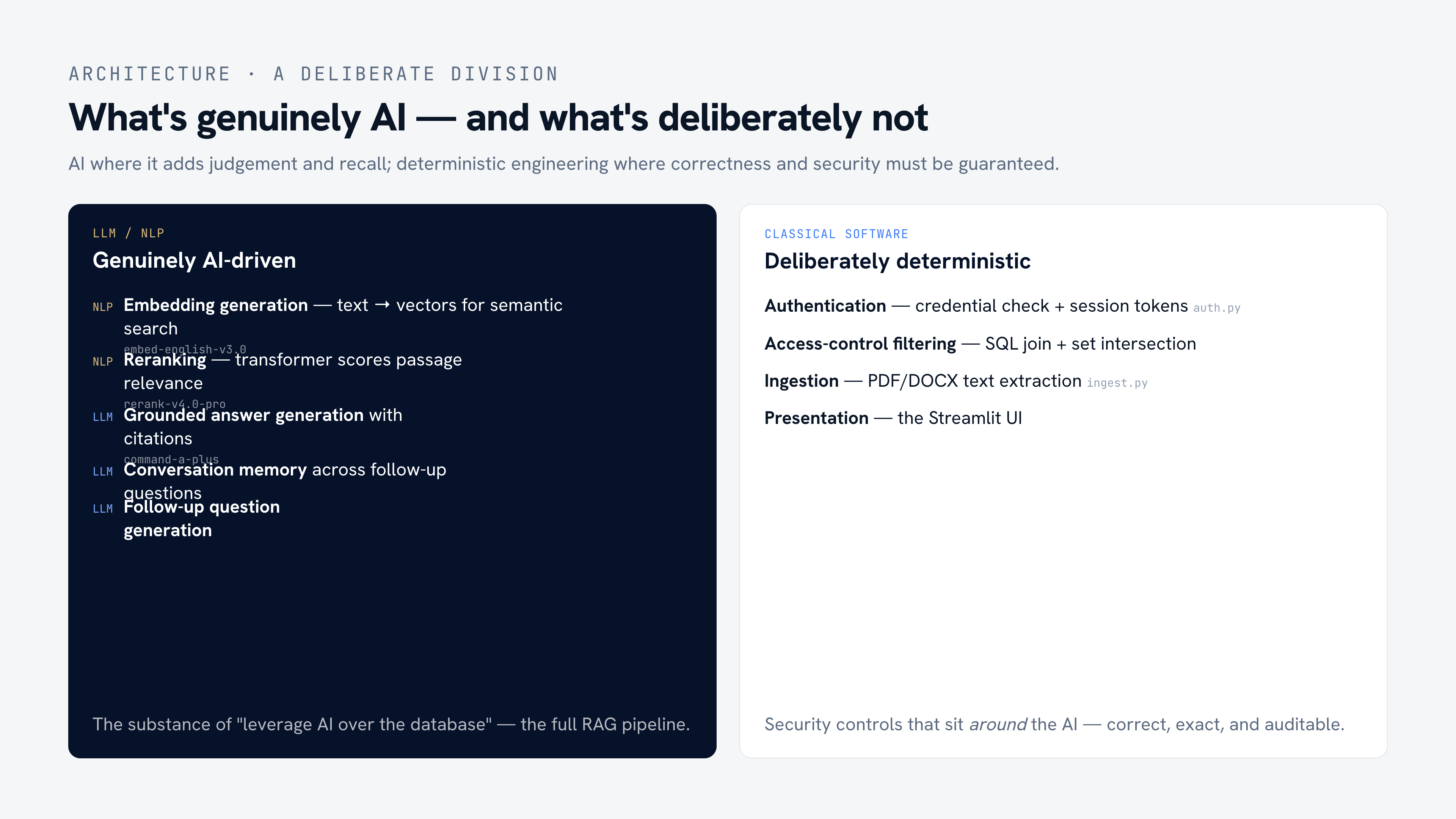
An assistant that lets planning staff interrogate manuals, procedures and doctrine in plain language, with every answer grounded in source and traceable to the page. Accuracy and traceability are built into the architecture; security is kept deterministic by design.
The demo runs on notional doctrine for illustration, not real classified material. Access requires a work email.
The documents are digital. The way staff use them is not.
All content now lives as PDF and DOCX in one central database.
No more physical textbooks scattered across desks and shelves.
Finding one planning factor can mean opening several 300-page documents.
A query only works if you already know the document's wording.
“Leverage AI over the new database to increase the efficiency and output of central planning staff, while accuracy and traceability remain key.”Chief of Staff
Four criteria the solution is measured against
Answers grounded only in retrieved source, no fabrication, no guessing.
Every claim links to the exact document, section and page it came from.
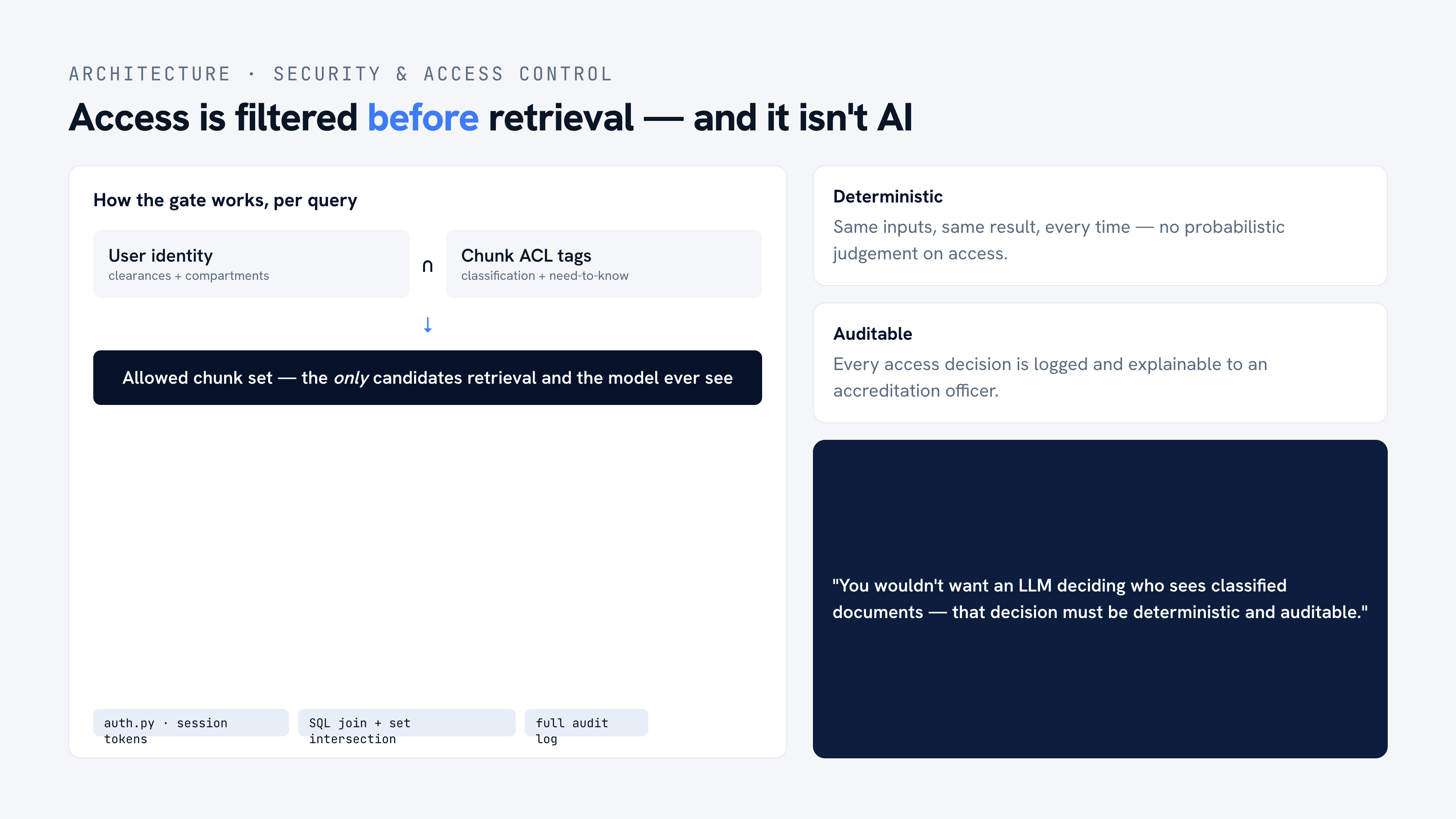
Users only ever see content their clearance and need-to-know permit.
Minutes of reading collapse into a sourced answer in seconds.
Ask in plain language. Get a grounded, cited answer.
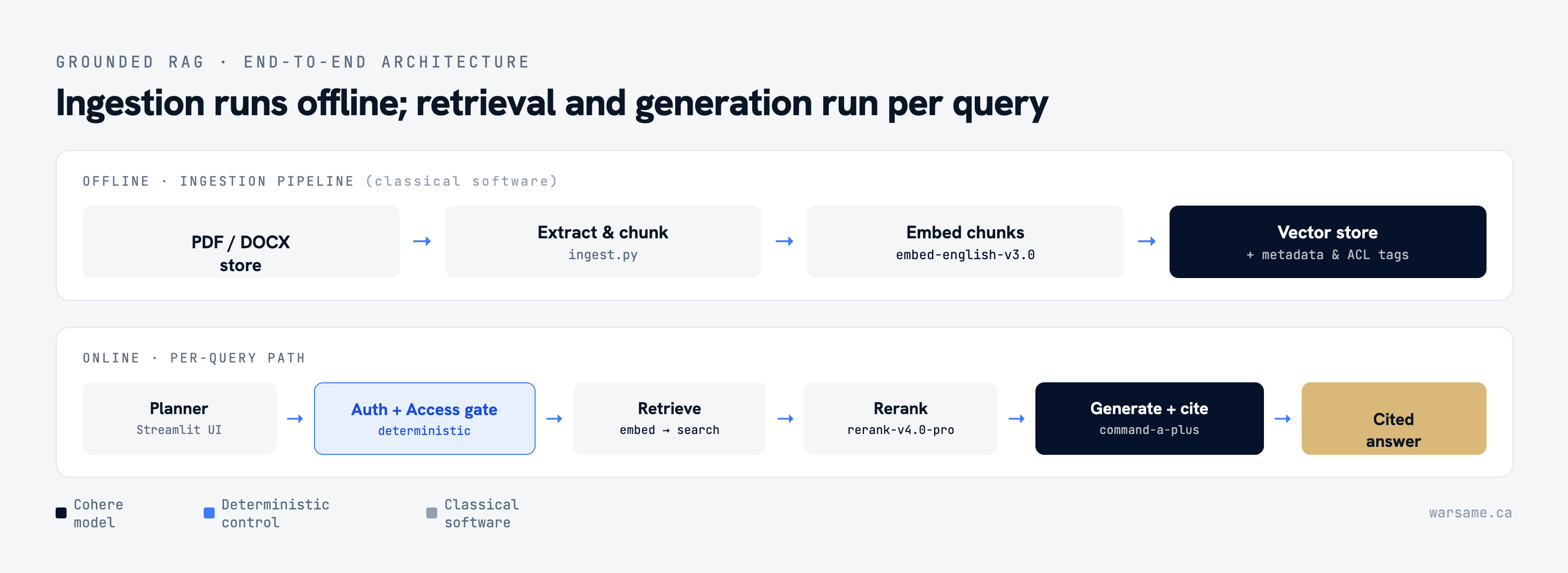
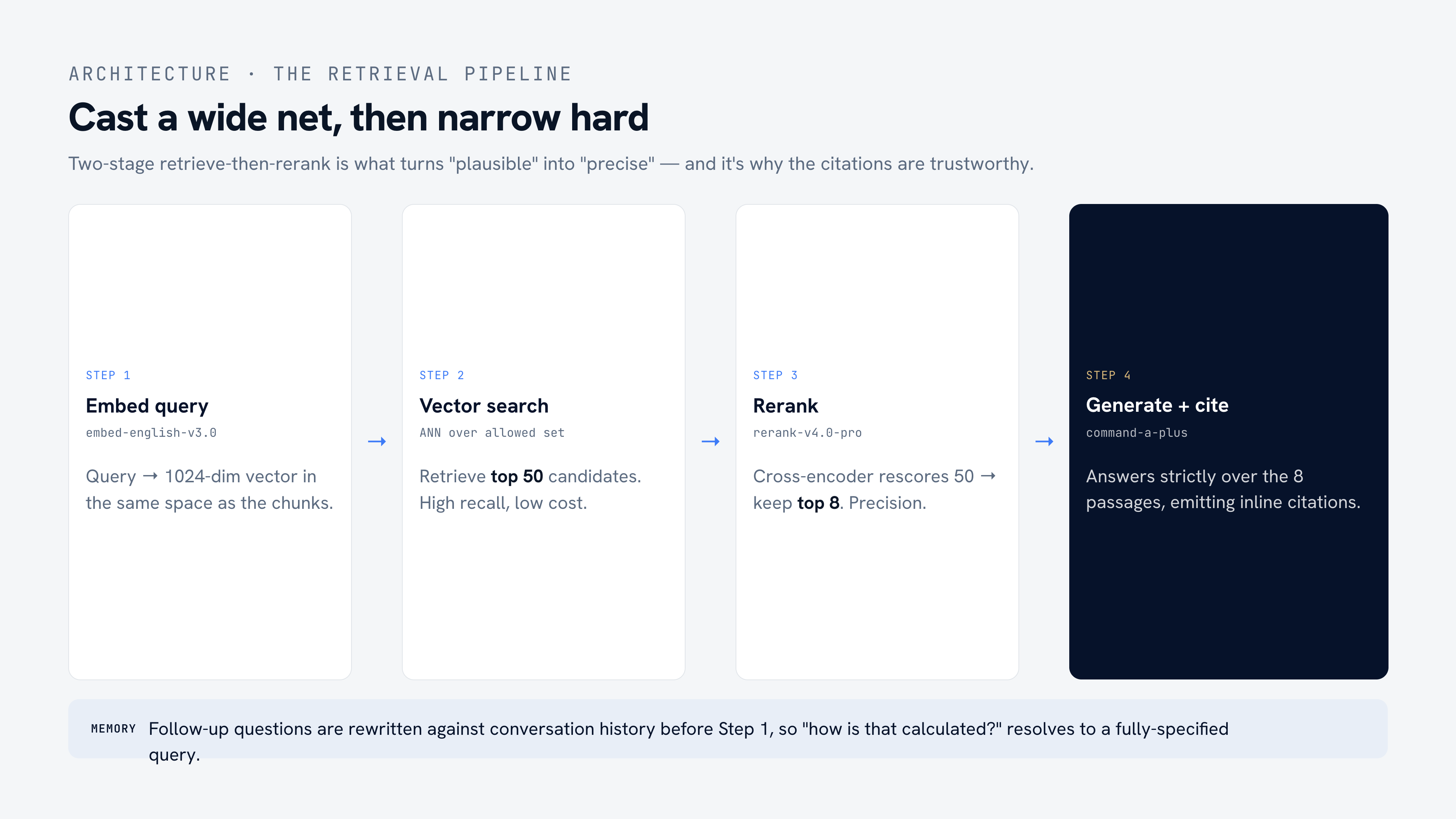
A retrieval-augmented assistant sits over the document estate. It retrieves the passages a user is cleared to see, reasons only over them, and returns an answer with inline citations that open the exact source. The interesting engineering is in what is not left to the model.
How it works
Ingestion runs offline; retrieval and generation run per query
Cast a wide net, then narrow hard
Access is filtered before retrieval, and it isn’t AI
What’s genuinely AI, and what’s deliberately not
Reading time becomes planning time
Illustrative pilot hypotheses, measured against DefTech's own baseline.
The same pipeline runs where accreditation requires
Start in cloud for the pilot, migrate on-prem without re-architecting.
- Fastest path to a working pilot
- Single-tenant, network-isolated deployment
- Elastic scaling, managed updates
- Ideal for an unclassified corpus to prove value
- Models run inside your security boundary, no data egress
- Full control of data residency and the update cycle
- Aligns with accreditation for classified material
- Runs on your hardware or a sovereign environment
Prove value first, accredit second, scale third
Baseline current effort. Assemble the golden Q&A set. Confirm corpus and access-control model.
~2 weeksOne directorate, unclassified corpus, cloud. Measure against the baseline.
~6 weeksMove to private deployment. Onboard classified material under full ACL.
accreditation-ledRoll out across directorates. Expand the corpus and monitor evaluation continuously.
ongoingEach phase has a clear exit gate, DefTech decides to proceed at every step.
The solution-architecture deck
The complete walkthrough, problem, architecture, security, deployment, evaluation methodology and risk register.
See the Defence Intelligence Assistant answer a live question
Ask it in plain language and watch it retrieve, reason and cite. The demo runs on notional doctrine, and access is protected by a work-email check, you'll receive a one-time code, then land straight in the tool.